.webp)

Why Is My AC Blowing Warm Air This Summer?
If you're wondering why is my AC blowing warm air, you're not alone — especially during a hot Twin Cities summer when the last thing you need is your cooling system letting you down. Here are the most common reasons:
Most Common Reasons Your AC Is Blowing Warm Air:
- Thermostat set incorrectly - Fan is set to "On" instead of "Auto," or mode is set to Heat
- Dirty air filter - Restricts airflow and can cause the evaporator coil to freeze
- Tripped circuit breaker - Outdoor unit loses power while indoor fan keeps running
- Low refrigerant or a leak - Prevents the system from absorbing heat effectively
- Dirty or blocked outdoor condenser unit - Can't release heat properly
- Frozen evaporator coils - Ice buildup blocks the cooling process
- Failing compressor or capacitor - Major mechanical issue requiring professional service
Walking into your home on a hot June afternoon expecting cool relief — only to feel warm, stuffy air blowing from your vents — is one of the most frustrating experiences a homeowner can face. The good news is that about 90% of the time, the root cause traces back to a handful of fixable issues, many of which you can check yourself in just a few minutes.
In this guide, we'll walk you through five straightforward troubleshooting steps to help you identify the problem and get your home comfortable again.
Understanding How Your Air Conditioning System Works
Before we dive into troubleshooting, it helps to understand how your air conditioner actually keeps your home cool. Many people believe an AC "creates" cold air and pumps it into the house. In reality, your air conditioner is a heat-mover. It works by absorbing heat from inside your home and transferring it outdoors.
This magic happens via the refrigeration cycle, which relies on a few critical components:
- The Evaporator Coil: Located inside your home (usually near your furnace or air handler), this coil is filled with cold liquid refrigerant. As warm air from your home is blown across the evaporator coil, the refrigerant absorbs the heat, leaving the air beautifully chilled before it is circulated back through your vents.
- The Compressor: Often called the heart of your HVAC system, the compressor sits in the outdoor unit. It pumps the heated refrigerant gas from the indoor coil to the outdoor coil, pressurizing it to prepare it for heat release.
- The Condenser Unit: This is the large metal box sitting outside in your yard. As the hot, pressurized refrigerant passes through the condenser coils, a large fan blows outdoor air across them to disperse the absorbed heat into the atmosphere.
If any part of this delicate thermodynamic dance is interrupted, the system fails to remove heat. When that happens, your fan will keep running, but it will only blow uncooled, warm air. For a deeper dive into this process, check out our guide on Why Is Your Air Conditioner Not Putting Out Cold Air.
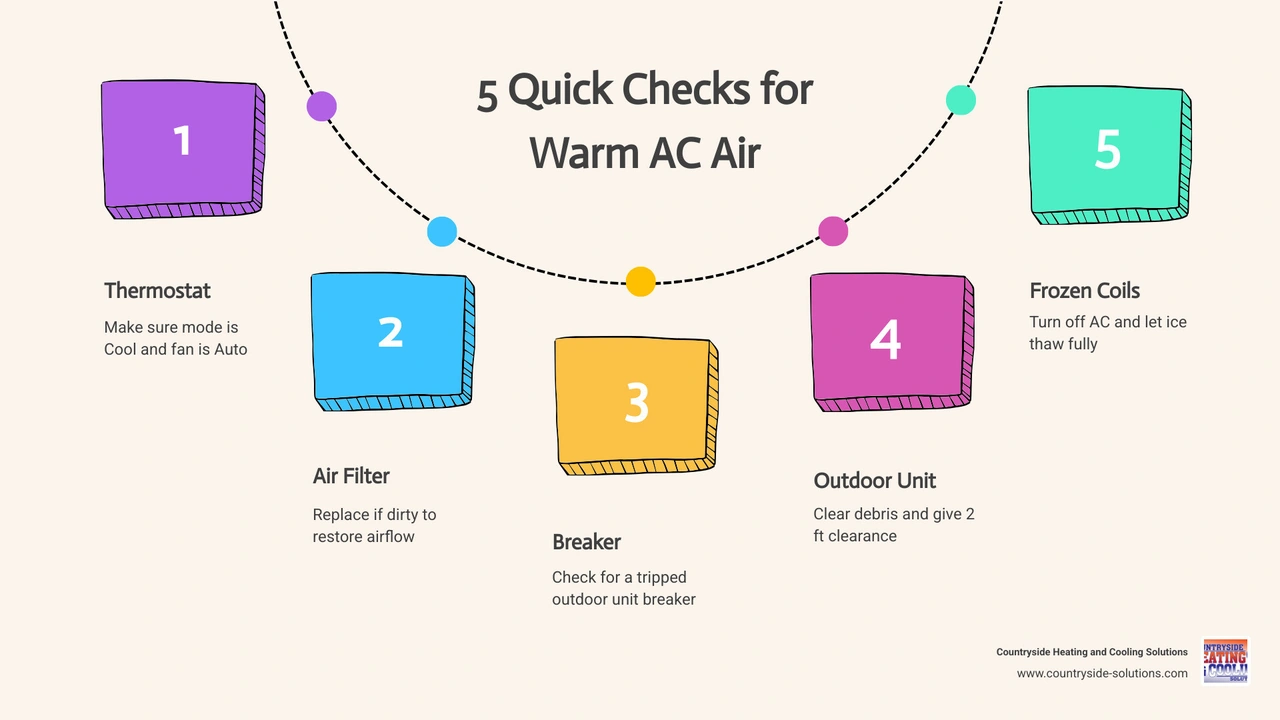
Why Is My AC Blowing Warm Air? 5 Troubleshooting Steps
When your home starts feeling more like a sauna than a sanctuary, don't panic. Before you pick up the phone, there are a few simple homeowner diagnostics you can perform.

By following these five easy steps, you can rule out the most common minor culprits and potentially save yourself an unnecessary service call. For more tips on basic fixes, you can read about How Do You Fix Your Air Conditioner That Is Not Cooling.
Step 1: Verify Thermostat Settings and Power Supply
It might sound silly, but the very first thing you should check is your thermostat. We have seen countless situations where a guest, a child, or an accidental bump changed the settings.
- Check the Mode: Ensure the thermostat is set to "Cool." If it was accidentally switched to "Heat" or "Fan Only," your AC will blow warm air.
- Check the Fan Setting: Make sure the fan is set to "Auto" rather than "On." When the fan is set to "On," the indoor blower motor runs continuously, even when the outdoor condenser isn't actively cooling. This results in warm air blowing through your vents between cooling cycles.
- Check the Batteries: If your thermostat display is blank or fading, replace the batteries. A weak battery can prevent the thermostat from sending a signal to your outdoor unit.
- Check the Circuit Breaker: Go to your home's electrical panel. Look for the breakers labeled "AC" or "Condenser." Sometimes, the indoor air handler and the outdoor condenser are on separate breakers. If the outdoor unit's breaker trips, the indoor fan will continue to blow warm air because the compressor outside isn't running to cool the refrigerant. Reset the breaker once if it has tripped; if it trips again immediately, do not force it, as this indicates an electrical fault.
Step 2: Inspect and Replace the Air Filter
A dirty air filter is the absolute leading cause of "ghost" AC problems. Over time, your filter collects dust, pet dander, and debris. If it isn't replaced regularly (every 1 to 3 months, especially during peak summer in Minnesota), it will cause severe airflow restriction.
When airflow is restricted, your system cannot draw enough warm air across the cold evaporator coil. Without that warm air to keep it balanced, the evaporator coil gets too cold, causing condensation to freeze on the coils. Once a thick layer of ice forms, it blocks the cooling process entirely, resulting in warm air and Poor Airflow From Your AC.
Step 3: Clear Debris Around the Outdoor Condenser Unit
About 90% of the time, the root cause of an AC blowing warm air traces back to the outdoor condenser unit. Because the outdoor unit is responsible for releasing the heat absorbed from your home, it needs plenty of breathing room.
Walk outside and inspect your condenser unit. Ensure there is at least a 2-foot clearance of open space around the entire unit. Remove any:
- Overgrown weeds, shrubs, or tall grass
- Fallen leaves, twigs, or lawn clippings
- Debris or pollen buildup on the metal fins
If the condenser coils are caked in dirt, the heat cannot escape, forcing the system to work harder and eventually blow warm air. You can gently wash the outside of the unit with a garden hose (never use a pressure washer, as it can bend the delicate aluminum fins).
Step 4: Check for Frozen Evaporator Coils
If your air filter was extremely dirty, or if your system is low on refrigerant, your indoor evaporator coils may have frozen.
To check for this:
- Look at the copper refrigerant lines entering your indoor air handler. Do you see frost or ice buildup?
- Look at the outdoor unit. Are the copper lines covered in ice?
- If you suspect ice, you must let the system thaw. Turn the AC off at the thermostat and switch the fan setting to "On." This will run the fan to circulate warm air and melt the ice safely over the next few hours. Do not turn the cooling back on until the ice is completely gone. To prevent this from happening again, review these Immediate Solutions For Common AC Issues.
Step 5: Listen for Unusual System Noises
Your ears can tell you a lot about the health of your air conditioner. Walk outside while the system is running and listen closely to the condenser.
- Hissing or Bubbling: If you hear a distinct hissing or bubbling sound, you likely have a refrigerant leak.
- Rattling, Buzzing, or Clicking: A loud buzzing or clicking sound often indicates a failing capacitor, contactor, or fan motor. If you hear a loud, metallic rattling or screeching, your compressor may be failing. If you notice these sounds, turn off the unit immediately. Read more about identifying these noises in our article on AC Making Buzzing Sound.
Serious AC Issues That Require Professional HVAC Service
While homeowners can easily handle thermostat settings and filter replacements, some problems are far too complex and dangerous for DIY attempts. Working with high-voltage electricity and pressurized chemical refrigerants requires specialized tools, training, and licensing.
| Symptom / Issue | DIY Troubleshooting | Professional HVAC Repair |
|---|---|---|
| Thermostat Settings | Verify set to "Cool" and "Auto" | Calibrate or replace faulty thermostat |
| Dirty Air Filter | Replace filter every 1-3 months | Inspect system for secondary ductwork damage |
| Tripped Breaker | Reset breaker once | Diagnose electrical shorts, replace weak breakers |
| Dirty Condenser Unit | Clear weeds/debris around unit | Chemically clean coils, repair damaged fins |
| Low Refrigerant / Leak | Not recommended (EPA violation) | Perform leak test, repair leak, recharge system |
| Failing Compressor | Not recommended (High risk) | Replace compressor or recommend system replacement |
| Failed Capacitor / Relay | Not recommended (High voltage) | Test and replace electrical components |
If you are experiencing any of the more complex issues listed above, it is vital to contact a professional. Ignoring these symptoms can lead to catastrophic system failure. Learn more about the warning signs in Signs That Your Air Conditioner Might Be Failing.
Why is my ac blowing warm air because of low refrigerant?
Refrigerant is the lifeblood of your air conditioner. Unlike fuel in a car, refrigerant is not "used up" or consumed during normal operation. Your AC is a sealed system, meaning the refrigerant simply cycles back and forth endlessly.
If your system is low on refrigerant, you have a leak. Simply adding more refrigerant (known as "topping off") is not a permanent fix and violates EPA regulations. A licensed technician must locate the leak in the copper lines, repair or seal the leak, evacuate the system, and then recharge the refrigerant to precise manufacturer specifications.
Why is my ac blowing warm air due to a failing compressor?
The compressor is the heart of your HVAC system. It is responsible for circulating the refrigerant under high pressure. Over time, due to age, poor maintenance, or running with a dirty filter, the compressor can wear out and fail.
When a compressor fails, it can no longer pump the refrigerant through the cycle, resulting in warm air blowing from your vents. Because the compressor is the most expensive component in an air conditioner, a failure here often leads to a major decision. Depending on the age of your system, you may need to evaluate whether to repair or replace the entire unit. For guidance on making this choice, see Is It Time To Repair Or Replace My Air Conditioner.
Frequently Asked Questions About Warm AC Air
Should I turn off my AC if it is blowing warm air?
Yes, absolutely. If your air conditioner is blowing warm air, you should turn it off at the thermostat immediately. Running a malfunctioning system can cause serious mechanical damage. For example, if the evaporator coils are frozen, liquid refrigerant can travel back to the compressor (a dangerous phenomenon known as "liquid slugging"), which can instantly destroy the compressor motor. Turning the system off protects these costly components and prevents minor issues from turning into major replacements.
Can a dirty air filter cause my AC to blow warm air?
Yes, a heavily clogged air filter is one of the most common causes of this issue. It restricts the airflow needed to transfer heat from your indoor air to the refrigerant. This restriction causes the evaporator coil to drop below freezing, leading to ice buildup that completely blocks the cooling cycle. Changing your air filters every 1 to 3 months is the easiest way to prevent these "ghost" problems. Explore other common issues in our guide on 7 Common AC Problems And How To Fix Them.
Why is my AC blowing warm air after a power outage?
Power outages and voltage surges can easily disrupt your HVAC system. A sudden outage can trip the outdoor unit's circuit breaker, damage the sensitive capacitor that helps start the compressor, or reset your smart thermostat to its default settings (which might turn the cooling mode off). If your system is blowing warm air after a storm, check your electrical panel first, and then check your thermostat settings.
Preventive Maintenance to Keep Your AC Blowing Cold
The best way to handle an air conditioner that blows warm air is to prevent it from happening in the first place. Regular, proactive care is the key to summer comfort, lower energy bills, and system longevity.
- Schedule Annual Tune-Ups: Having a professional inspect your system every spring ensures that hidden electrical issues, dirty coils, and minor refrigerant leaks are caught before they leave you sweating in the middle of July.
- Change Filters Monthly: Check your air filters every 30 days during the peak summer cooling season and replace them as needed.
- Keep the Outdoor Unit Clean: Regularly clear away grass clippings, leaves, and cottonwood fuzz from your outdoor condenser unit to maintain proper heat transfer.
For more hands-on advice on keeping your system running at peak performance, check out our AC Maintenance Tips To Increase The Performance Of Your Unit.
Conclusion
When your air conditioning system starts blowing warm air, getting fast, reliable help is essential to restoring peace and comfort to your home. Since 1974, Countryside Heating and Cooling Solutions has been the trusted name for home comfort across Maple Plain, MN, and the greater Minneapolis-Saint Paul metro area.
Our team of licensed, NATE-certified technicians is dedicated to keeping your home cool and efficient all summer long. With our family-owned values and our guaranteed next-business-day service, you can rest easy knowing that expert help is always just a phone call away.
If your DIY troubleshooting steps didn't solve the problem, don't sweat it out alone. Contact us today to schedule your professional Air Conditioning Services and bring the refreshing cool air back to your Twin Cities home!
