.webp)

Why Summer AC Maintenance Tips for the Twin Cities Matter Before the Heat Hits
If you're looking for summer AC maintenance tips for the Twin Cities, here's a quick rundown of the most important steps:
- Replace your air filter every 1–3 months (more often with pets or allergies)
- Clear debris from around your outdoor condenser unit and maintain 2 feet of clearance
- Clean your vents and registers to keep airflow strong
- Test your thermostat and set it to cooling mode before summer arrives
- Check for warning signs like weak airflow, warm air, or unusual noises
- Schedule a professional AC tune-up between March and May — before peak season
Twin Cities summers are short but intense. Average highs hover around 79°F, and humidity can spike fast — pushing your AC to work harder than it does almost anywhere else in the country. That rapid swing from Minnesota winters to humid summer heat creates what HVAC professionals call "thermal shock" — your system goes from months of sitting idle to running full tilt almost overnight.
The result? Systems that haven't been maintained tend to struggle right when you need them most. And since home cooling can account for roughly half of a summertime electric bill in Minnesota, a system that's working harder than it should is hitting your wallet too.
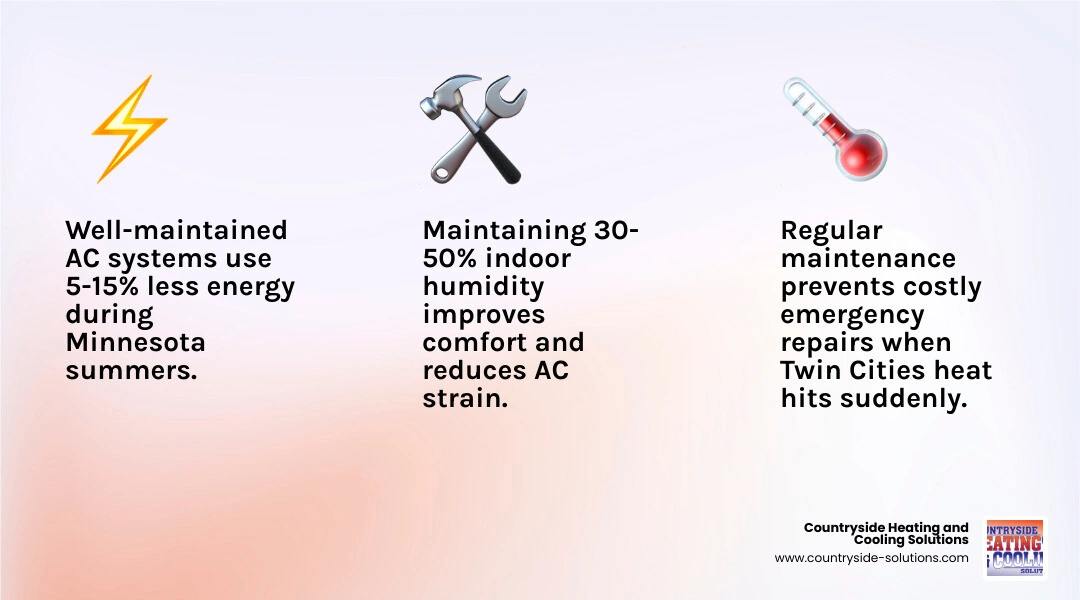
A little preparation in spring goes a long way. A well-maintained AC can use 5 to 15 percent less energy than a neglected one — and it's far less likely to leave you sweating on a 90-degree July evening waiting for an emergency repair.
Essential DIY Summer AC Maintenance Tips for the Twin Cities
Taking care of your cooling system doesn't require an engineering degree. While complex repairs and deep component cleaning are best left to licensed professionals, there are several straightforward DIY tasks you can perform to keep your system humming efficiently.
Proactive homeowner care directly impacts both your energy bills and your system's overall lifespan. When you perform regular DIY checks, you prevent dust buildup, keep airflow paths open, and ensure the outdoor unit can release heat effectively. To help you get started, we have compiled the 6 Best Summer Maintenance Tips for Your Air Conditioner to guide you through the process.
By investing just a little bit of time in Getting Your AC Ready for Minnesota Summer, you avoid the peak-season rush and keep your monthly utility costs manageable.
To help you understand where your DIY efforts end and where professional expertise begins, here is a quick breakdown:
| Maintenance Task | DIY Friendly? | Professional Recommended? | Frequency |
|---|---|---|---|
| Checking & replacing air filters | Yes | No | Every 30 to 90 days |
| Clearing yard debris & weeds from condenser | Yes | No | Monthly during summer |
| Gently rinsing outdoor condenser coils | Yes | Yes (for deep clean) | Annually |
| Checking thermostat operation | Yes | No | Start of the season |
| Calibrating thermostat & electrical testing | No | Yes | Annually |
| Checking & balancing refrigerant levels | No | Yes (Required by law) | Annually |
| Clearing clogged condensate drain lines | Yes (basic) | Yes (deep flush) | Annually |
Air Filter Care: Summer AC Maintenance Tips for the Twin Cities
The single most important DIY task for any homeowner in Eden Prairie, Minnetonka, or Maple Grove is changing the air filter. Your HVAC filter acts as the lungs of your system, trapping dust, pollen, pet dander, and other airborne particles before they can enter your equipment.
When a filter becomes clogged, it acts like a wall. Your blower motor has to work twice as hard to push cool air through the house, which can increase your cooling system's energy consumption by up to 15%. Over time, this restricted airflow can even cause your indoor evaporator coils to freeze over, leading to a complete system shutdown.
To keep things running smoothly, you should check your filter once a month. The general rule of thumb for replacement is:
- 1-inch filters: Change every 1 to 3 months.
- 4-inch media filters: Change every 4 to 6 months.
If you have shedding pets, household members with severe allergies, or live near active construction in growing suburbs like Waconia or Delano, you will want to replace them closer to the 30-day mark. For step-by-step instructions on choosing and installing the right filter, check out our guides on How Often Should You Change Your HVAC Air Filter and How to Replace a Furnace AC or Heat Pump Filter. Remember to look at the MERV (Minimum Efficiency Reporting Value) rating: a rating between 8 and 11 is typically the sweet spot for residential homes, balancing excellent filtration with optimal airflow.
Outdoor Condenser Care: Summer AC Maintenance Tips for the Twin Cities
Your outdoor AC unit (the condenser) has a tough job. It takes the heat collected from inside your home and releases it into the outdoor air. To do this efficiently, the metal fins surrounding the unit need constant, unobstructed airflow.
In the Twin Cities metro area, our outdoor units face unique seasonal challenges. Late spring brings a heavy blanket of cottonwood seeds that can coat condenser coils like a thick felt blanket. Add in grass clippings from lawn mowing, dry autumn leaves, and creeping weeds, and your condenser can quickly choke.
To protect your system, follow these steps to keep the outdoor unit clean:
- Maintain a 2-foot clearance zone: Trim back any bushes, flowers, weeds, or low-hanging branches within two feet of the unit.
- Clear away loose debris: Turn off the power to your AC unit at the outdoor disconnect box, then brush away leaves and twigs from the base.
- Gently rinse the coils: Use a garden hose with a gentle spray pattern to rinse away built-up dirt and cottonwood seeds from the metal fins. Never use a pressure washer, as the high pressure will bend the delicate aluminum fins and permanently block airflow.
- Straighten bent fins: If you notice bent metal fins, you can use a specialized fin comb to gently restore them to their upright position.
For a deeper dive into protecting your outdoor unit from our local elements, take a look at our guide on how to Get Ready for Summer AC Tips to Keep You Cool.
Managing Humidity and Airflow in the Land of 10,000 Lakes
With our thousands of lakes and rivers, Minnesota summers get incredibly muggy. This high humidity makes the outdoor air feel much hotter and heavier than it actually is. Inside your home, excess moisture can make rooms feel sticky, clammy, and stuffy.
Your air conditioner is actually designed to act as a dehumidifier. As warm, moist indoor air passes over the cold evaporator coils, the moisture condenses onto the coils and drains away through a condensate line. However, during extreme humidity spikes, your AC has to work twice as hard to remove moisture before it can even begin to lower the air temperature.
To maintain true indoor comfort and protect your home from mold or mildew, keep these humidity and airflow strategies in mind:
- Target 30% to 50% indoor humidity: This is the ideal range for comfort, structural protection, and health.
- Run ceiling fans counterclockwise: In the summer, your ceiling fans should rotate counterclockwise to create a cool breeze effect. This doesn't actually lower the room's temperature, but the wind-chill effect makes the air feel 4°F cooler on your skin, allowing you to set your thermostat higher.
- Consider a whole-home dehumidifier: If your home struggles with a persistent "stuffy" feeling, integrating a whole-home dehumidifier into your existing ductwork is a game-changer. It removes moisture independently of your AC, saving energy and reducing wear on your cooling system.
- Keep your vents open: Avoid the temptation to close register vents in unused rooms or basements. Your central HVAC system is designed for a specific volume of airflow; closing vents creates pressure imbalances that can damage your compressor.
For more specialized advice on managing our unique climate, check out our Summer Cooling Tips for Twin Cities Homeowners.
When to Schedule a Professional AC Tune-Up
While DIY care keeps the worst of the dirt at bay, your cooling system still needs a professional eye once a year. Think of it like a doctor's check-up or an oil change for your car—preventive care now saves you from massive headaches later.
The absolute best window to schedule a professional AC tune-up in the Twin Cities is during the spring, specifically between March and May. Booking your service during this time ensures your system is fully prepared before the first 90-degree day of June arrives. It also gives you maximum scheduling flexibility before HVAC technicians enter their busiest emergency repair season.
But how do you know if your system is already struggling and needs immediate professional attention? Watch out for these common warning signs:
- Weak airflow: If the air coming out of your registers feels like a gentle whisper rather than a steady breeze, your blower motor or ductwork may have issues.
- Warm air blowing from vents: If your system is running but the air isn't cold, you could be dealing with a failed capacitor, a clogged condenser, or a refrigerant leak. If you experience this, read our troubleshooting guide on an Air Conditioner Not Blowing Cold Air.
- Frequent short-cycling: If your AC turns on and off every few minutes without ever cooling your home completely, it is working under extreme stress.
- Unusual noises: Squealing, clanking, or grinding noises usually point to a loose belt, failing bearings, or a failing motor.
- Spiking utility bills: A sudden, unexplained jump in your electric bill means your system's efficiency has plummeted.
During a professional tune-up, a technician will clean your internal coils, check and tighten all electrical connections, test the system's starting capabilities, clear the condensate drain line to prevent water damage, and verify that your refrigerant charge is correct. This comprehensive care is the single best way to protect your system, and you can learn more about its benefits in our article on AC Maintenance Tips to Increase the Performance of Your Unit.
Frequently Asked Questions About Twin Cities AC Care
How often should I change my AC filter during a Minnesota summer?
During peak summer usage (June through August), you should check your filter every 30 days. For standard 1-inch filters, plan to replace them every 30 to 60 days. If you have multiple pets, household members with asthma or allergies, or live in a dusty area, monthly replacements are highly recommended to maintain healthy airflow and clean indoor air.
Why is my AC running constantly but not cooling my home?
This is a common issue that usually stems from restricted airflow or heat transfer. The most frequent culprits are a heavily clogged air filter, a thick layer of cottonwood seeds blocking your outdoor condenser unit, or low refrigerant levels due to a leak. Additionally, if your system is outdated or improperly sized, it will struggle to keep up with high outdoor temperatures. If you're concerned about indoor air quality or persistent coughs related to your system, check out our article: Is Air Conditioning Making Your Cough. If you suspect your system is improperly sized for your home, you can read more about What Size AC Do You Need to understand how capacity affects performance.
What is the best temperature to set my thermostat in the summer?
For an ideal balance of comfort and energy efficiency, the U.S. Department of Energy recommends setting your thermostat to 78°F when you are at home. When you leave for work or go out for more than 8 hours, adjusting your thermostat 7 to 10 degrees higher can save you up to 10% on your annual cooling costs. Utilizing a programmable or smart thermostat makes these adjustments seamless, ensuring you return to a cool home without wasting energy while you are away.
Conclusion
Getting your home ready for the heat doesn't have to be stressful. By combining consistent monthly DIY tasks—like checking your air filters and keeping your outdoor unit clear of lawn debris—with an annual professional tune-up, you can enjoy reliable comfort all summer long.
When you need professional support, the team at Countryside Heating and Cooling Solutions is here to help. Family-owned and operated since 1974, we have proudly served homeowners across Maple Plain, Minnetonka, Wayzata, Eden Prairie, and the surrounding western suburbs for over fifty years. Our licensed, NATE-certified technicians are committed to providing outstanding workmanship, honest advice, and a guaranteed next-business-day service to keep your home perfectly comfortable.
Don't wait for the first major heatwave to find out if your air conditioner is up to the task. Contact us today to learn more about our comprehensive Air Conditioning Services or to schedule your seasonal tune-up!
