.webp)

Why the Best HVAC Setup for Minnesota Weather Is Not a One-Size-Fits-All Decision
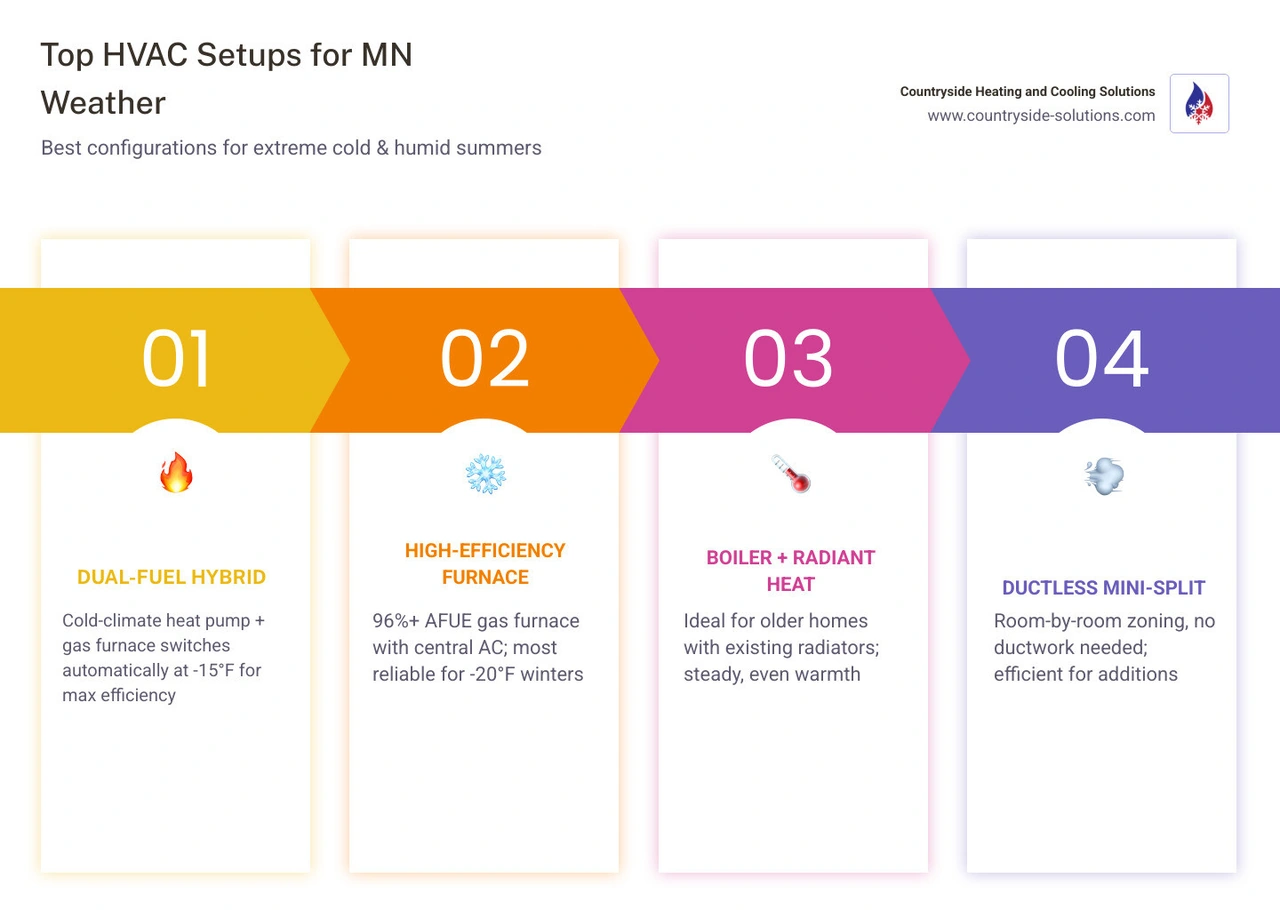
The best hvac setup for Minnesota weather combines a high-efficiency gas furnace with a cold-climate heat pump in a dual-fuel (hybrid) configuration — giving you reliable heat during brutal sub-zero winters and energy-efficient cooling and heating during milder seasons. For older homes without ductwork, a boiler system or ductless mini-splits are strong alternatives.
Quick answer — top HVAC setups for Minnesota homes:
- Dual-fuel hybrid system (cold-climate heat pump + gas furnace) — Best overall for most Twin Cities homes
- High-efficiency gas furnace (96%+ AFUE) + central AC — Most reliable for extreme cold, lower upfront complexity
- Boiler with radiant heat — Best for older homes with existing radiators or radiant floors
- Ductless mini-split system — Best for homes without existing ductwork or for room-by-room zoning
If you've lived through a Minneapolis winter, you already know your heating system isn't a luxury — it's a lifeline. Minnesota's climate is genuinely punishing: winters that routinely drop to -20°F or colder, summers that bring real humidity and heat, and temperature swings of up to 40 degrees in a single day. That's not a climate where a basic or undersized HVAC system cuts it.
Heating and cooling account for more than half of the average household's energy use. In Minnesota, where the heating season stretches from October through April, that number hits even harder on your utility bills. Choosing the wrong system — or running the right system without proper maintenance — means higher costs, uneven comfort, and the very real risk of a breakdown on the coldest night of the year.
At Countryside Heating and Cooling Solutions, we've been helping homeowners across the Minneapolis–Saint Paul metro stay warm, cool, and comfortable since 1974. This guide breaks down exactly what works in our climate, what doesn't, and how to make a smart decision for your home.
Why Minnesota’s Climate Demands a Specialized HVAC Configuration
Minnesota is categorized primarily into Climate Zone 6, a region defined by its extreme seasonal contrasts. In the Twin Cities metro area, we deal with "The North Star State" factor: atmospheric conditions that can swing from -30°F in January to 95°F with 80% humidity in July. These aren't just numbers; they are mechanical stressors that force your equipment to work 8 to 12 cycles per hour during peak cold snaps.
What makes our weather uniquely challenging?
- Thermal Cycling Stress: Extreme cold causes metal components to expand and contract rapidly, which can lead to cracks in furnace heat exchangers over time.
- Humidity Management: Our summers aren't just hot; they are swampy. An HVAC system that only cools without properly dehumidifying can lead to mold growth in ductwork.
- Sub-Zero Reliability: When the "Polar Vortex" hits, your system must generate enough BTUs to overcome massive heat loss through walls and windows.
Understanding What Are the Most Common Types of HVAC Systems is the first step in realizing why a standard system designed for a state like Georgia will fail here. Below is a comparison of what your HVAC system faces throughout the year in cities like Maple Plain or Wayzata:
| Season | Typical Temperature Range | Humidity Levels | Primary HVAC Goal |
|---|---|---|---|
| Winter | -20°F to 30°F | 5% – 35% (Extremely Dry) | High-output heating & humidification |
| Spring | 35°F to 65°F | 40% – 60% | Mild heating & air filtration (pollen) |
| Summer | 70°F to 95°F | 50% – 80%+ (Very Humid) | Cooling & dehumidification |
| Fall | 30°F to 60°F | 45% – 55% | Transition heating & system prep |
Finding the Best HVAC Setup for Minnesota Weather
As of May 2026, technology has advanced to the point where we no longer have to choose between "powerful" and "efficient." The modern gold standard is the hybrid (dual-fuel) system. By combining an electric air-source heat pump with a high-efficiency gas furnace, you get a system that adapts to the weather outside in real-time.
Learn the Facts About Heat Pumps to understand that they don't just "create" heat; they move it. In the summer, they act as high-efficiency air conditioners. In the spring and fall, they provide incredibly cheap and comfortable heat. But when the Minnesota winter truly arrives, the gas furnace takes over to handle the heavy lifting.
Knowing Know the Signs When to Replace Your Old HVAC System is vital. If your current furnace is over 15 years old or your AC is struggling to keep up with July humidity, it’s time to look at these advanced configurations.
Why Hybrid Systems are the Best HVAC Setup for Minnesota Weather
A hybrid system is essentially two systems working as one. It utilizes a cold-climate air-source heat pump (ccASHP) and a gas furnace.
- Automatic Switching: The system is smart. When it's 35°F outside, the heat pump runs, using electricity to move heat into your home. This is often 200-300% more efficient than burning gas. As the temperature drops below a certain threshold (usually around 5°F to -10°F depending on the model), the system automatically pivots to the gas furnace.
- Inverter Technology: Modern heat pumps use variable-speed compressors. Instead of being "all on" or "all off," they modulate their speed to maintain a perfect, steady temperature, eliminating the hot and cold spots common in older homes.
- Efficiency Gains: Upgrading to a hybrid setup can significantly improve your HVAC System Energy Efficiency, often reducing electricity consumption by 50% or more compared to older electric resistance heating.
Choosing the Best HVAC Setup for Minnesota Weather in Older Homes
If you live in a historic home in Excelsior or Orono, you might not have the ductwork required for a standard furnace. In these cases, the best hvac setup for Minnesota weather often involves:
- High-Efficiency Boilers: Boilers provide radiant heat through baseboards or radiators. Unlike forced air, radiant heat doesn't blow dust around and provides a very steady, "gentle" warmth that many Minnesota homeowners prefer.
- Ductless Mini-Splits: These are perfect for supplemental heating and cooling. If you have a finished attic or a room that is always too cold, a mini-split provides zoned comfort without the need for massive renovations.
- Zoning Systems: For multi-story homes, zoning allows you to heat the bedrooms at night while keeping the living areas cooler, which is one of the best ways to How Do You Extend Your HVAC Life by reducing unnecessary run time.
Comparing Heating Solutions: Furnaces vs. Cold-Climate Heat Pumps
The debate used to be "Heat Pump vs. Furnace," but in 2026, the conversation is about how they work together.
The High-Efficiency Furnace (The Heavyweight)A modern furnace with a 96% AFUE (Annual Fuel Utilization Efficiency) rating means that 96 cents of every dollar spent on gas goes directly into heating your home. These units are built for the "Polar Vortex." They offer:
- Fast recovery times when you turn the thermostat up.
- Reliability in temperatures as low as -30°F.
- Two-stage or modulating gas valves for quieter operation.
The Cold-Climate Heat Pump (The Efficiency Expert)Modern ccASHPs are a far cry from the heat pumps of the 1990s. Thanks to vapor injection technology, these units can now extract heat from the outdoor air even when it is -15°F. However, because their efficiency drops as it gets colder, we still recommend a backup heat source for those deep-freeze February nights.
When preparing for winter, refer to our HVAC Maintenance Checklist for Extreme Cold Climates.
High-Efficiency Furnace Features to Look For:
- Variable-Speed Blower Motor: Adjusts airflow to prevent cold blasts.
- Secondary Heat Exchanger: Captures extra heat that would otherwise go out the chimney.
- Self-Diagnostic Boards: Helps technicians identify issues quickly during a tune-up.
Essential Maintenance and Indoor Air Quality for the North Star State
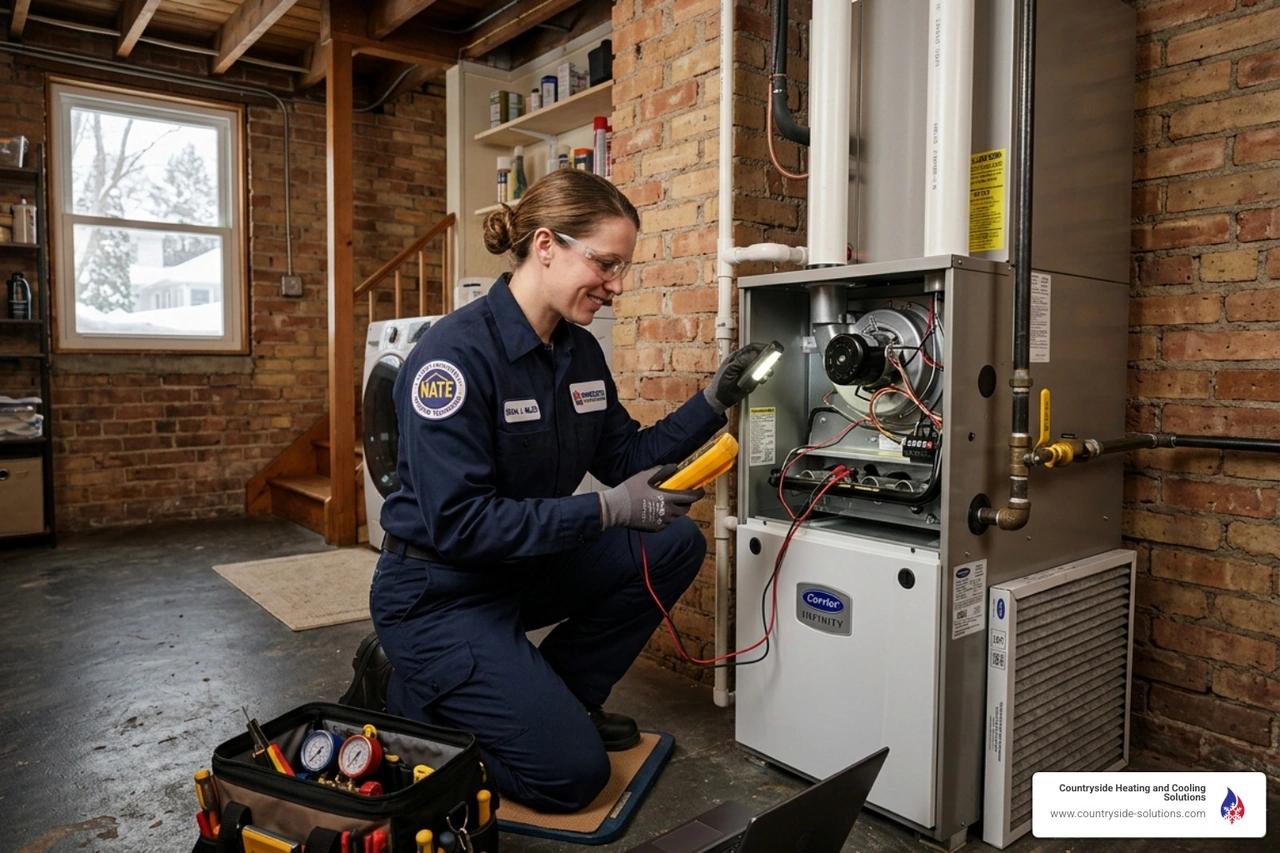
In Minnesota, our homes are built "tight" to keep the heat in. While this is great for your gas bill, it’s bad for your lungs. Without proper ventilation, indoor air becomes stagnant, trapping allergens, pet dander, and moisture.
Indoor Air Quality (IAQ) Solutions:
- HRVs and ERVs: Heat Recovery Ventilators (HRV) and Energy Recovery Ventilators (ERV) are mechanical lungs for your home. They bring in fresh outdoor air and exhaust stale indoor air while "pre-heating" the incoming air so you don't lose energy.
- Whole-Home Humidifiers: Minnesota winters are notoriously dry. When indoor humidity drops below 20%, it can cause cracked wood furniture, static shocks, and respiratory discomfort. A whole-home humidifier keeps you in the "sweet spot" of 30-50% humidity.
- Filtration: We recommend MERV 11 or MERV 13 filters to catch fine dust and agricultural particles common in the western suburbs.
Regular upkeep is non-negotiable. Follow our HVAC Maintenance Tips for Minnesota Homeowners and don't forget to check our Summer HVAC Maintenance Tips to ensure your condenser isn't clogged with cottonwood seeds or grass clippings.
Maximizing Savings with Minnesota Energy Rebates for HVAC Upgrades
Upgrading to the best hvac setup for Minnesota weather is a significant investment, but there are numerous ways to offset the cost. In 2026, several programs are available to local homeowners:
- Federal IRA 25C Tax Credit: Provides a 30% tax credit (up to $2,000 annually) for qualifying cold-climate heat pumps.
- Xcel Energy & CenterPoint Rebates: Local utilities offer substantial rebates for high-efficiency furnaces (95%+ AFUE) and SEER2 rated air conditioners.
- Utility Discounts: Some providers offer discounted electricity rates for homes that use heat pumps as a primary heating source.
We keep a close eye on these opportunities. Check out our guide on Minnesota Energy Rebates for HVAC Upgrades for the latest requirements and SEER2 rating benchmarks.
Conclusion
Choosing the best hvac setup for Minnesota weather isn't just about picking a brand; it's about engineering a solution that fits your specific home and lifestyle. Whether you are in Maple Plain, Minnetonka, or any of the surrounding Twin Cities suburbs, Countryside Heating and Cooling Solutions is here to help. Our NATE-certified technicians have been the backbone of this family-owned business since 1974, ensuring every installation is done with the quality and care your family deserves.
What is the ideal thermostat setting for Minnesota winters and summers?
To balance comfort and cost, we recommend the following:
- Winter: Set your thermostat to 68°F when you are home.
- Summer: Set it to 78°F for cooling.
- The 8-Hour Rule: You can save up to 10% a year on heating and cooling by turning your thermostat back 7–10 degrees for eight hours a day (while sleeping or at work).
Using a smart thermostat makes this automatic. However, even the best thermostat can't fix a failing system. Be sure to know How Often Should You Service Your HVAC in Minnesota to keep those settings effective.
Are cold-climate heat pumps viable as a primary heating solution in Minnesota?
Yes, modern cold-climate air-source heat pumps (ccASHPs) are viable, but with a caveat. While they can operate down to -15°F, their heating capacity diminishes as the temperature drops. In the Twin Cities, we almost always recommend a dual-fuel setup. This ensures that if we hit a week of -20°F weather, your gas furnace can take over, providing total peace of mind. To ensure your heat pump is always ready for the shift, ask yourself: Is an HVAC Maintenance Plan Worth It? For most Minnesota homeowners, the answer is a resounding yes.
How often should I perform HVAC maintenance in the Twin Cities?
We recommend a bi-annual service schedule: a precision furnace tune-up in the fall and an AC or heat pump check in the spring. This schedule helps identify "brewing problems" before they become emergency repairs in the middle of a blizzard.
Curious about what goes into a visit? What Does an HVAC Maintenance Plan Include provides a full breakdown of our process. For more detailed advice, visit our More info about HVAC maintenance services page.
Don't wait for the next polar vortex to find out your system isn't up to the task. Contact us today to schedule a consultation and ensure your home is "North Star State" strong.
